American tech giants are moving from lobbying to shipping. A month after urging policymakers to avoid “premature restrictions” on open-weight AI, Meta and Nvidia both released free, downloadable AI models this week, stepping up competition with Chinese labs that have dominated the open-source scene.
Meta on Monday unveiled Muse Glimmer and said it would open the weights for its latest model, Muse Spark 1.2. CEO Mark Zuckerberg described the move as part of a broader strategy to release the company’s most powerful AI models to the open-source community. A day later, Nvidia debuted Nemotron 3.5 Lightning, an evolution of its Nemotron 3 family from December, which the chipmaker says is “truly open source” because it publishes training datasets, techniques, and model weights for developer inspection.
The releases contrast sharply with the proprietary approach of OpenAI and Anthropic, and they come as open-weight AI has become a flashpoint from Silicon Valley to Washington. Critics warn that Chinese models pose national security risks and that distillation — a training technique that can involve using another model’s outputs — amounts to intellectual property theft. Industry leaders counter that restricting open models would concentrate power and slow innovation.
“The age of AI can be one of prosperity,” a consortium of tech companies wrote in an open letter on July 24. “With the right choices, open weight AI can expand opportunity, strengthen competition, extend American technological leadership, mitigate risk, and ensure that the benefits of this extraordinary technology are shared broadly across our economy.”
The letter also defended distillation as “a widely used technique for model improvement, evaluation, and validation.”
A crowded field
Meta and Nvidia now face an audience already served by popular Chinese open-weight models from Moonshot AI, DeepSeek, and Alibaba’s Qwen. The new U.S. entries are smaller, designed to run on laptops for tasks like powering on-device digital agents — not necessarily to out-benchmark frontier systems.
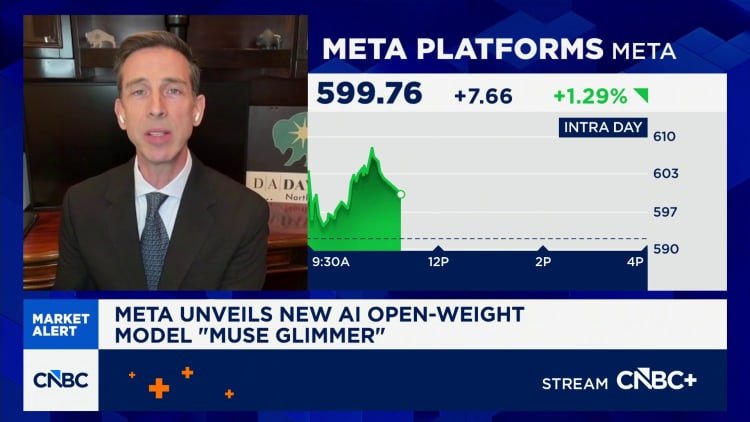
Box CEO Aaron Levie, a signatory of last month’s letter, called Zuckerberg’s plan for Muse Spark 1.2 a “very big deal,” saying it rivals top foundation models from Anthropic and OpenAI. “There’s a very firm flag in the ground that America will have near-frontier open-source models,” Levie said.
He also pointed to a practical edge for domestic models: enterprises and government agencies that might shy away from Chinese open-weight software could be more willing to experiment with Meta’s offerings. “You probably wouldn’t be able to put a non-domestic open-source model in a major government agency, as an example, and you wouldn’t be able to use it at very large banks most likely,” Levie said. “If you think about the kind of use cases that now Muse can be used in, it actually opens up a tremendous amount of potential.”
Trust issues
Meta’s return to open weights is not without friction. The company previously pushed open-source with its Llama lineup, but the April 2025 release of Llama 4 underwhelmed developers. Meta then spent billions overhauling its AI unit, putting Scale AI CEO Alexandr Wang in charge. Under Wang, the team has rolled out proprietary Muse-branded models to build revenue streams — a shift that left some developers feeling burned.
Umesh Sachdev, CEO of business AI startup Uniphore, said Meta “burned bridges” with third-party developers when it moved from open to proprietary models. “I think it’s going to take more than a 3,500 worded article from Zuck to convince developers,” he said, referring to Zuckerberg’s accompanying manifesto. “The emotion of my developers at Uniphore, they almost feel betrayed.”
Still, Sachdev said he’s rooting for domestic success, “because more competition will drive down token cost, and will drive up innovation, and it’s always good for consumers.”
Forrester analyst Charlie Dai echoed that sentiment, calling Meta’s latest move “strategically important because it restores a major U.S. frontier AI vendor to the open ecosystem.” He said developers and enterprises will likely welcome the shift back to open weights for its transparency, customization, and deployment flexibility — though Meta must now “prove it can cultivate a durable ecosystem beyond releasing competitive models.”
Source: www.cnbc.com — https://www.cnbc.com/2026/08/12/meta-nvidia-open-weight-ai-race-china.html
This article is for informational purposes only and does not constitute financial, investment, tax, or legal advice. Do your own research and consult a licensed professional before making financial decisions.