
Inflation readings that strip out statistical outliers have tumbled to their lowest levels in years, offering a more encouraging picture of price pressures than headline figures suggest, though Federal Reserve officials remain divided on what the data means for monetary policy.
The Dallas Fed’s trimmed mean measure showed the one-month annualized inflation rate for June at just 1.4%, down 1.3 percentage points from May and marking the lowest reading since November 2020, according to CNBC. The 12-month rate, which central bankers typically watch more closely, declined to 2.2% — down 0.2 percentage point from the prior month and the lowest since July 2021.
These alternative metrics work by excluding extreme price movements on both ends of the spectrum. The Dallas Fed measure, for instance, tosses out 24% of the lowest price changes and 31% of the highest to calculate a midpoint that theoretically better represents underlying inflation trends. The Cleveland Fed uses a similar methodology with its 16% trimmed mean, which registered 2.63% for June based on the consumer price index — the lowest since May 2021 on an unrounded basis.
The improvement in these measures comes as Fed Chairman Kevin Warsh has signaled his intention to broaden the central bank’s approach to monitoring inflation beyond traditional gauges. That shift could give trimmed mean data more prominence in policy discussions.
Market Implications and Diverging Views
Citigroup economist Andrew Hollenhorst noted that the fact underlying inflation continues slowing toward the Fed’s 2% target across multiple indicators has become particularly relevant given Warsh’s stated willingness to examine a broader range of metrics. Hollenhorst expects markets to price out anticipated rate hikes in coming months based on inflation data, and potentially price in cuts if unemployment rises as the bank projects.
The trimmed mean readings contrast with the headline personal consumption expenditures price index released by the Commerce Department, which showed the all-items measure falling 0.1% for the month largely due to sharply lower fuel costs, while the core reading excluding food and energy gained 0.1%. On an annual basis, those gauges rose 3.7% and 3.3% respectively.
Internal Fed Debate Continues
Not everyone at the Fed is convinced the trimmed mean measures tell the full story. Dallas Fed President Lorie Logan, whose institution produces one of the key trimmed mean gauges, has cautioned against over-interpreting the data due to compositional factors. Her researchers have found that changes in the mix of price increases and decreases are causing the measure to exclude too many price gains at present, potentially making it read lower than the true inflation trend.
Logan this week dissented from the Federal Open Market Committee’s decision to hold its benchmark interest rate steady, preferring instead a quarter-percentage-point increase. She argued that even after accounting for productivity gains and temporary supply shocks, inflation appears to be trending toward the mid-2% range rather than all the way to the 2% target, with risks skewed to the upside.
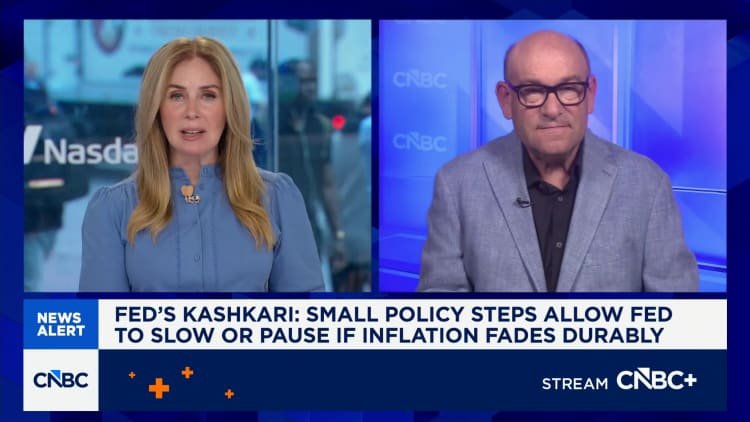
She was joined in dissent by Minneapolis Fed President Neel Kashkari and Cleveland Fed President Beth Hammack, both of whom expressed concern that inflation remains uncomfortably high and warrants immediate action rather than patience.
Markets reacted to the Fed’s decision to hold rates steady with a surge in bond yields, particularly at the long end of the curve where investors attempt to price in future growth and inflation expectations. The move suggested some market participants worry the central bank may be easing its stance prematurely.
Warsh himself expressed only measured confidence in the current inflation trajectory. While citing some potentially positive signs from production data, the chairman emphasized the Fed still has considerable work ahead. He acknowledged that more than five years of above-target inflation cannot be resolved in a matter of weeks or by a single month of modest price decreases, stressing that policymakers have begun a new chapter in their approach to price stability.
Source: www.cnbc.com — https://www.cnbc.com/2026/07/31/these-fed-alternative-indicators-show-inflation-is-at-lowest-in-years.html
This article is for informational purposes only and does not constitute financial, investment, tax, or legal advice. Do your own research and consult a licensed professional before making financial decisions.