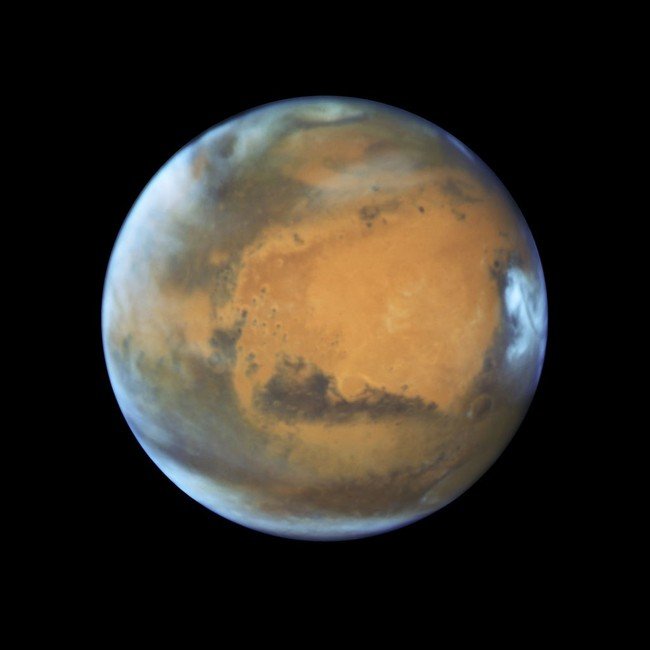
President Donald Trump is going all-in on putting Americans on Mars, a gamble that comes at the expense of NASA’s unmanned space program, according to a PJ Media report by Rick Moran.
In his 2025 inaugural address, Trump declared, “Americans are explorers, builders, innovators, entrepreneurs and pioneers,” and pledged to “pursue our manifest destiny into the stars.” He is now asking Congress for $1 billion to fund Mars research, with no specific timetable other than “as soon as possible.”
Robotic Missions Sacrificed
The most significant casualty is the Mars Sample Return Mission. The Perseverance rover has collected Martian soil samples that could indicate past life. The original plan—launched in 2020—was to send another lander to fetch those samples and return them to a lab in Earth orbit to prevent contamination. But independent reviews from 2023 to 2025 found the architecture too complex and expensive; costs grew from an initial $7 billion estimate to over $11 billion, with a return date slipping to 2040. Given that timeline, waiting for humans, who might arrive by 2045, could make more sense.
Trump’s strategy also involves a public-private partnership, with commercial space companies providing infrastructure. A nuclear-powered rocket and a new crew vehicle are planned, with launch possibly occurring from a lunar base. The administration has prioritized returning to the Moon, but Artemis program delays may push a crewed lunar landing to 2029—and China could beat the U.S. there by months.
Space Race with China
Moran argues the real driver is competition with China. Since returning to office, Trump has issued multiple executive orders to counter Chinese influence and ensure American space superiority. He ordered NASA to land astronauts on the Moon by 2028 and establish the first elements of a permanent lunar outpost by 2030 to “prepare for the journey to Mars.” Almost every part of the U.S. space program is being redirected toward the red planet.
Other projects are being abandoned. The International Space Station will soon be retired, replaced by smaller, commercially built stations. That would leave China’s Tiangong as the largest low-Earth orbit station. Moran writes that if China wins all three races—Moon, space station, and proving life on Mars—it could reshape the international order, leading many nations to see China as the dominant power of the century.
NASA’s broad budget requests have targeted dozens of robotic planetary, space physics, and Earth-observation missions for phase-out or cancellation. The agency also proposed consolidating extended science operations into a single hub to cut overhead. The kind of basic exploration NASA is known for is being phased out.
Costs and Risks
John Grunsfeld, former NASA head of science, argues trading robotic science for a crewed mission doesn’t make sense. But Moran notes that public support for NASA has always hinged on human missions, not “spectacular photos of Pluto or Mars rovers.”
Even with private investment, a Mars mission could cost $70 billion in tax dollars—and that assumes humans can get there and back alive. Unanswered questions include the effects of nearly three years in zero gravity, psychological strain of prolonged close quarters, and exposure to solar radiation and cosmic rays.
Moran concludes that a thousand questions remain before sending humans to Mars is justified. “It’s nice to imagine Americans on Mars, but then what? After finding (or not finding) life or evidence of past living things, what can humans do on Mars that robots can’t?”
Source: pjmedia.com — https://pjmedia.com/rick-moran/2026/08/26/trump-goes-all-in-on-americans-being-first-to-set-foot-on-mars-n4956553
This article is for informational purposes only and does not constitute financial, investment, tax, or legal advice. Do your own research and consult a licensed professional before making financial decisions.