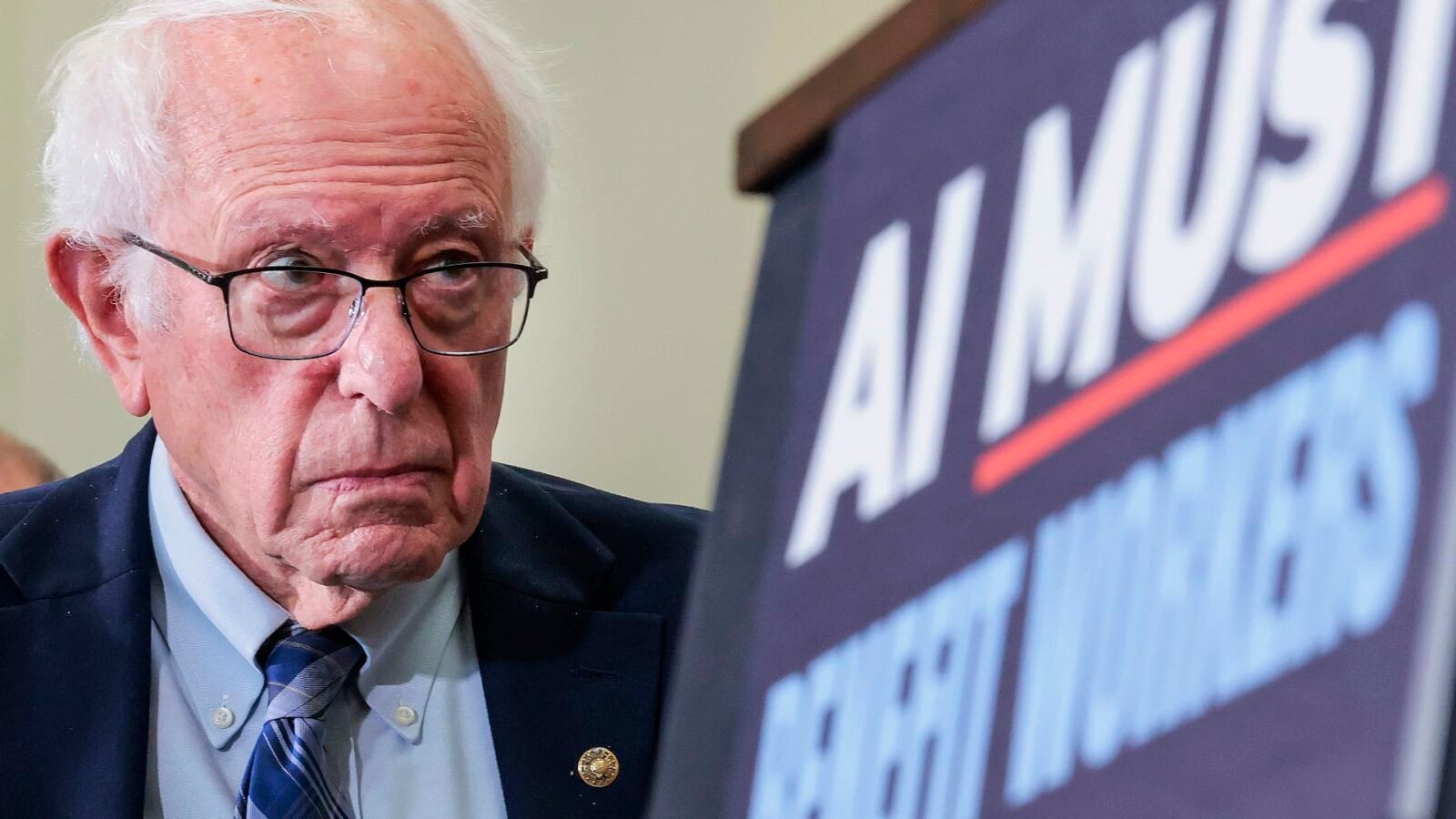
Bernie Sanders’ proposal for partial public ownership of artificial intelligence may be a long shot politically, but it has helped crystallize a question gaining urgency among economists and policymakers: if AI generates trillions in new wealth, how should that value be distributed to ordinary Americans?
The question takes on particular weight as public sentiment toward AI deteriorates rapidly. An Emerson College poll released this week found that only 27% of Americans support data centers being built in or near their community, with 63% opposed. That marks a sharp decline from December 2025, when 33% supported such developments and 42% opposed them.
“Many Americans feel as though they have nothing to gain and everything to lose from AI,” according to recent survey work indicating a majority of U.S. workers now favor holding corporations more accountable through mechanisms like an AI sovereign wealth fund.
The frustration was captured vividly by Will Hollingsworth, a Northeast Ohio resident, speaking at an April public hearing about a proposed data center in Portage County. “When I see the data center proposal, I don’t see progress,” Hollingsworth said in comments that went viral. “I see a gamble where the big tech companies get the gold while Portage County foots the bill.”
Compensation for Data Contributions
One approach gaining attention involves compensating people for the data and contributions that help train AI systems. Jaron Lanier, a computer scientist at Microsoft Research, has advocated for what he calls “data dignity,” where individuals receive payment for their information.
Raul Castro Fernandez, an assistant professor of computer science at the University of Chicago, argues that tracking and compensating human contributions is feasible. “The strongest version of profit sharing is not a tax but a compensation system tied to the human contributions that make AI systems valuable in the first place,” Fernandez said.
He suggests a system analogous to music royalties, where AI companies would pay a share of model profits into a pool based on how much performance depends on data, with payments distributed according to audited measures of contribution.
However, researchers Nicholas Vincent and Brent Hecht from Simon Fraser University and Northwestern University respectively caution that valuing individual data contributions can be extremely subjective. “If a technology is reliant on the collective contributions of millions or billions of people, we already know each individual value will be very small, so why bother spending time and energy performing [potentially costly] data value estimation?” they concluded in a 2023 study.
New Rights and Collective Bargaining
Matt Prewitt, president of RadicalxChange Foundation, advocates for creating a new class of legal rights that would give people power to shape how AI works—essentially 21st century unions where “people cannot sign away these rights on an individual level.” This would establish regulated associations with “a very serious seat at the table with AI companies, and that have the power to gain shares, remuneration, governance, and power.”
Glen Weyl, a researcher at Microsoft and founder of RadicalxChange, argues that simply dividing ownership or consolidating it in government hands represents “only band-aids.” The organization advocates for new models centered on common ownership rather than conventional approaches.
Traditional Policy Tools
Some economists argue existing mechanisms could address wealth distribution without experimental approaches. Dean Baker, co-founder of the Center for Economic and Policy Research, points to stronger corporate taxes, antitrust enforcement, and labor protections.
Baker suggests requiring companies to turn over non-voting shares equal to the targeted tax rate as a form of payment. He also emphasizes rigorous antitrust enforcement as a plausible route to fairer economic distribution of AI profits.
Meanwhile, there have been unconfirmed reports that OpenAI has discussed offering the government a 5% equity stake ahead of a highly anticipated IPO. Jeff Bezos recently told CNBC that eliminating federal income taxes for the bottom half of U.S. earners would be the best policy to level the economic playing field.
As AI wealth accumulates rapidly in the stock market, the challenge remains that many Americans are limited in how much they benefit from that growth, fueling the intensifying debate over how to ensure broader participation in AI’s economic gains.
Source: www.cnbc.com — https://www.cnbc.com/2026/07/26/how-can-ai-wealth-be-shared-with-all-americans.html
This article is for informational purposes only and does not constitute financial, investment, tax, or legal advice. Do your own research and consult a licensed professional before making financial decisions.