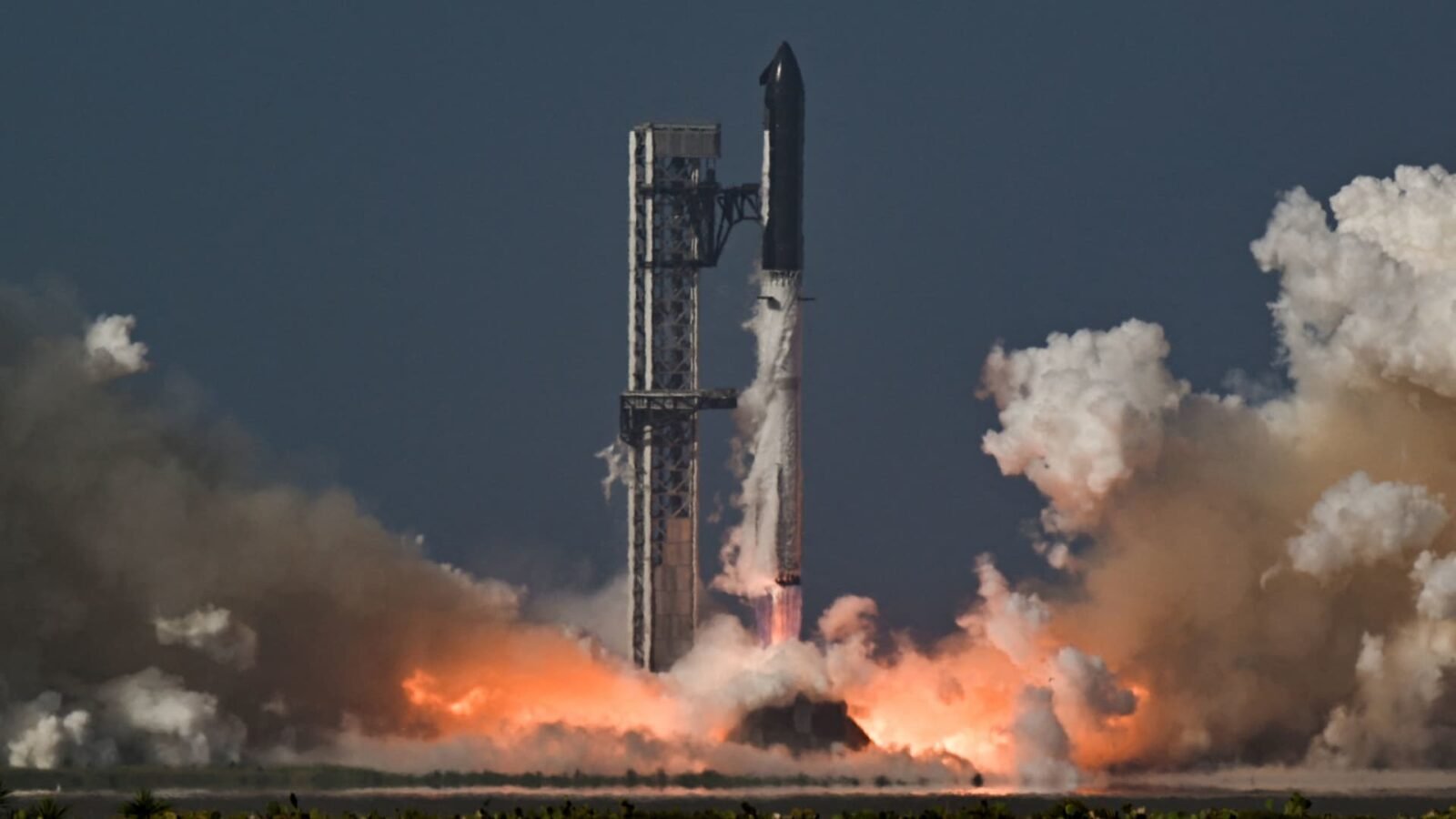
SpaceX launched its massive Starship rocket Friday evening from Starbase, Texas, marking the company’s first test flight since completing a record initial public offering last month. The launch came as the aerospace company’s stock has fallen significantly from recent highs.
The test flight, dubbed “lucky number 13” by SpaceX employees, saw the rocket’s Super Heavy booster separate from the Starship spacecraft approximately two minutes after liftoff. The booster executed a controlled splashdown in the Gulf of Mexico, while the upper stage completed a soft landing in the Indian Ocean.
A key milestone came about 18 minutes into the flight when SpaceX successfully deployed 20 new Starlink V3 satellites into orbit. The satellites, which were designed to burn up after roughly 20 minutes, represented the company’s first opportunity to evaluate the performance of its latest generation hardware in flight conditions.
The new satellites, manufactured at SpaceX’s Redmond, Washington facility, are substantially larger and more capable than previous versions. According to a SpaceX business analyst speaking during the company’s livestream, the V3 satellites feature solar arrays that generate twice the power of earlier generations.
Technical Challenges Remain
Despite the successful deployment, industry analysts noted ongoing technical hurdles. Tim Farrar, a satellite services expert with TMF Associates, said the test flight demonstrated progress but highlighted that SpaceX “remains a long way from achieving rapid reusability of the entire ship.”
Farrar pointed to difficulties SpaceX encountered relighting its Raptor engines during Friday’s flight. He warned that similar failures during attempted landings at the launch site could result in severe damage to the launchpad infrastructure.
Friday’s launch was the second test flight for Starship V3, the latest iteration of what SpaceX has designed to be the largest rocket ever built or flown. The company engineered Starship to be fully reusable and capable of lifting greater cargo volumes at lower cost compared to existing launch systems.
Broader Mission Goals
Starship plays a central role in SpaceX’s strategy to dramatically expand its Starlink satellite network. The company is also developing Starmind satellites, which are intended to function as orbital data centers once deployed.
Beyond commercial satellite launches, SpaceX aims to use Starship to return American astronauts to the lunar surface and eventually enable crewed missions to Mars. The company is currently preparing the rocket for a major NASA test flight scheduled for next year.
Launch Delays and Stock Performance
The Friday evening launch followed multiple delays. SpaceX postponed an earlier test flight planned for Thursday due to weather conditions. The company also scrubbed a July 16 attempt after the rocket’s booster triggered a hold that shut down engines just as they were beginning to ignite, according to SpaceX personnel during that day’s livestream.
SpaceX shares have declined in four of the past five weeks, falling 43 percent from their peak closing price on June 16. The stock’s recent performance stands in contrast to the enthusiasm that surrounded the company’s IPO last month.
Source: www.cnbc.com — https://www.cnbc.com/2026/07/24/spacex-launches-massive-starship-rocket-in-first-test-flight-since-ipo.html
This article is for informational purposes only and does not constitute financial, investment, tax, or legal advice. Do your own research and consult a licensed professional before making financial decisions.