Asian semiconductor stocks suffered steep losses Tuesday, with memory chip manufacturers bearing the brunt of a selloff that stretched across the region’s technology sector.
SK Hynix plunged more than 13%, while Samsung Electronics fell over 12% as investors reassessed the trajectory of artificial intelligence spending. The decline spread beyond Korea’s chip giants, with Samsung SDI dropping over 10%, LG Innotek sliding nearly 18%, Seoul Semiconductor falling about 7%, and LG Chem losing more than 6%.
The weakness extended to Japan, where Tokyo Electron dropped almost 11% and Advantest slid over 10%. SoftBank Group, viewed as a major proxy for AI investment through its stake in Arm, fell 6.3%. Shares of Kioxia, Japan’s computer memory manufacturer, plunged more than 18%.
Taiwan Semiconductor Manufacturing Company declined 2.9%, while mainland China’s tech-heavy ChiNext 300 index was down 4.7%. The Hang Seng China Semiconductor Chips Index fell 5%.
Spillover from Wall Street
The Asian market turmoil followed another weak session for U.S. semiconductor stocks Monday. The VanEck Semiconductor ETF lost more than 2%, adding to losses from Friday. Advanced Micro Devices and Teradyne dropped 5% and 4%, respectively, while Micron Technology shed about 2%.
The synchronized decline highlights the tight linkage between Asian technology shares and U.S. AI investment trends. Samsung Electronics and SK Hynix rank among the world’s largest suppliers of high-bandwidth memory chips used in AI servers, making their stock prices particularly sensitive to shifting expectations for spending by major cloud computing providers.
Uncertainty Over AI Investment Cycle
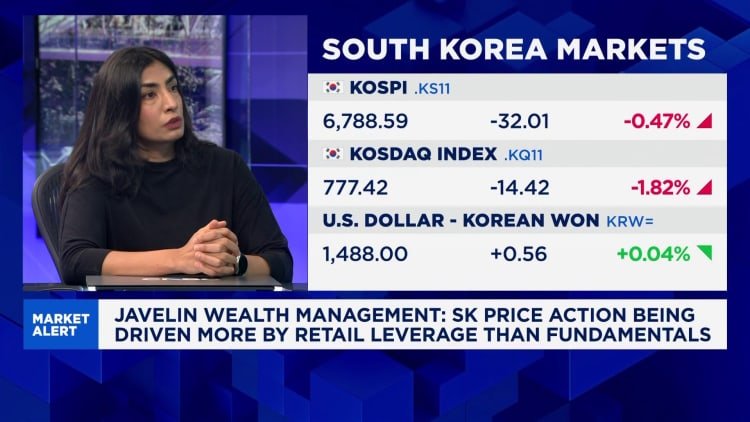
According to Owen Lamont, senior vice president at Acadian Asset Management, the sharp swings in SK Hynix shares reflect deep uncertainty surrounding the AI investment cycle and limited visibility into how the technology will ultimately affect the economy.
“Right now we’re facing an incredible uncertainty,” Lamont told CNBC. “No one has any idea how this AI process is going to affect our economy, and so I think it’s going to be rocky no matter what.”
Lamont suggested that leveraged exchange-traded products could be amplifying market swings, even if they aren’t solely responsible for the recent volatility in SK Hynix. “More generally, the entire ecosystem of levered ETFs in Korea, also in Hong Kong and in the United States, are possibly adding volatility and magnifying market fluctuations,” he said.
Memory Price Concerns
Sundeep Gantori, chief investment officer for equities at Standard Chartered, said the selloff also reflects deteriorating sentiment toward semiconductor stocks following recent media reports highlighting China’s ambitions in memory chips and lithography equipment.
He noted that broker reports suggesting memory prices will peak in 2027 contributed to Tuesday’s weakness in Korean markets. While Standard Chartered expects memory prices to peak next year, Gantori emphasized that current valuations have improved the risk-reward profile for investors.
Despite the near-term turbulence, Gantori maintained an optimistic long-term outlook. “The market opportunity remains sufficiently large for multiple players to benefit and coexist,” he said, with the AI investment cycle continuing to support leading technology companies.
Source: www.cnbc.com — https://www.cnbc.com/2026/07/28/sk-hynix-plunges-semiconductor-selloff-deepens-samsung-softbank.html
This article is for informational purposes only and does not constitute financial, investment, tax, or legal advice. Do your own research and consult a licensed professional before making financial decisions.