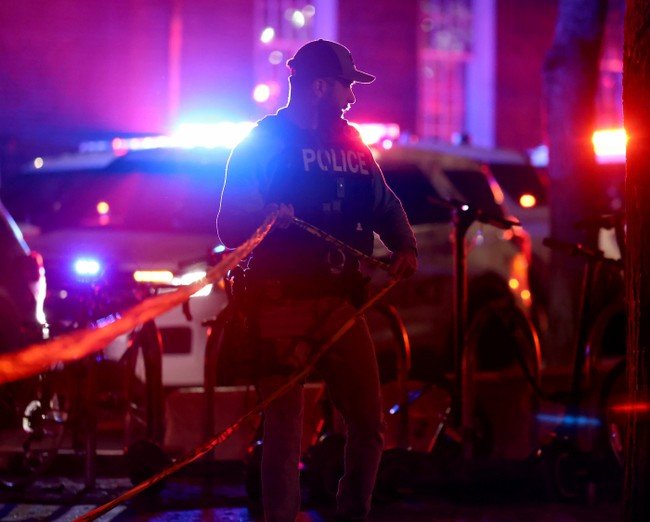
Violent crime in America’s big cities has fallen to levels not seen in over a century, and the achievement has ignited a familiar political slugfest: who gets the credit? For conservatives, the answer is simple — Donald Trump. The logic, as laid out in a PJ Media analysis, is that if crime had risen on his watch, the president would have been blamed, so he deserves the praise when it plunges.
But the data tells a more complicated story. The post-COVID surge in violence began receding as early as 2022, well before Trump’s second term. Murders spiked 29% in 2020 and rose another 4.3% in 2021, while aggravated assaults jumped more than 12%. By 2022, the trend had started to flatten — and then began a steady decline that has continued into 2026.
According to a joint report from the Council on Criminal Justice (CCJ) and the Regional Justice Information Service (RJIS), the national homicide rate in 2025 is projected to be the lowest since at least 1900, following the historic 30% surge from 2019 to 2020. Data through the first half of 2026 shows the decline has not only held but accelerated, moving well beyond the tentative ‘return to normal’ phase.
What’s Driving the Drop?
The report is careful not to credit any single factor. Researchers point to changes in criminal justice operations and strategies, technological advances, and broad societal and cultural shifts. In a USA Today op-ed, CCJ President and CEO Adam Gelb emphasized that three major forces are moving at once, making it nearly impossible to disentangle their individual contributions.
In a separate analysis for the Fulcrum, Senior Research Specialist Ernesto Lopez highlighted explanations ranging from community prevention programs to broader behavioral trends. The PJ Media piece scoffs at such vagueness, suggesting that gang members aren’t suddenly behaving better. But the report itself acknowledges the complexity of the phenomenon.
Guns, Police, and D.C.’s Turnaround
The analysis does concede, somewhat grudgingly, that a surge in gun ownership may have played a role. Between 2020 and 2025, an additional 100 million guns entered private hands. Research cited in the report suggests roughly 30 million Americans acquired guns between 2021 and 2024, including over 11 million first-time owners. The PJ Media author argues this, combined with increased incarceration of violent criminals, had a far greater impact than violence prevention or prisoner re-entry programs.
Police, too, are back to doing their jobs after the pandemic-era disruptions, the report notes. Despite high-profile failures of ‘no bail’ policies in some cities, the old-fashioned theory that locking up violent offenders reduces crime has been validated again.
Nowhere is the turnaround more striking than in Washington, D.C. The nation’s capital recorded 424 homicides across 2020–2021, peaking at 274 in 2023. But in the first half of 2026, D.C. reported just 46 homicides — a 43.9% drop from 82 in the same period the year before. Notably, the decline began even before the National Guard was deployed, and it cratered afterward, along with other violent-crime metrics.
The Political Fight Over Credit
The downward trend has sparked a political fight over who deserves credit, with each side offering a clean, convenient narrative. But oversimplifying the story risks misunderstanding the forces at play and the policies needed to sustain progress, the CCJ warns.
For now, the good news stands on its own. Violent crime remains far higher than it should be, but the direction is unmistakable. The report’s authors argue that removing impediments to further progress should be the work of Congress — a message that both parties will likely twist to their advantage in the months ahead.
Source: pjmedia.com — https://pjmedia.com/rick-moran/2026/08/11/trump-is-to-blame-for-record-low-crime-rate-in-big-cities-n4956020
This article is for informational purposes only and does not constitute financial, investment, tax, or legal advice. Do your own research and consult a licensed professional before making financial decisions.