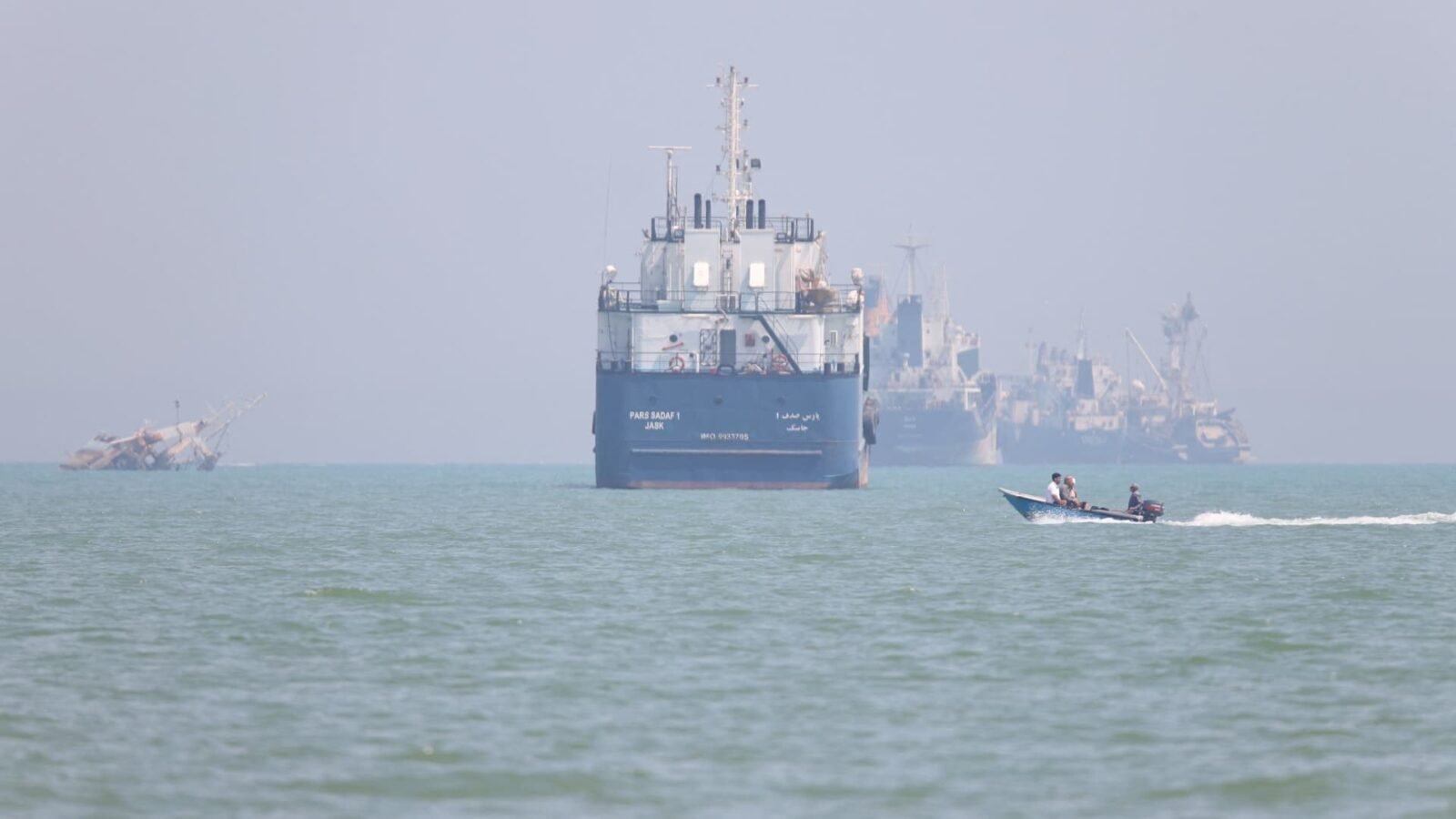
Oil tankers are coming under fire across three critical maritime regions as escalating conflicts in the Middle East and Europe threaten global energy flows and drive crude prices sharply higher.
Iran has intensified attacks on tankers in and around the Strait of Hormuz this month, while Tehran’s Houthi allies in Yemen have opened a new front by targeting Saudi tankers in the Red Sea. Ukraine, meanwhile, has struck more than 150 vessels linked to Russia’s shadow fleet in the Black Sea and Sea of Azov, according to the Kyiv Post.
Brent crude broke through $100 per barrel on Thursday for the first time since May, surging more than 30% in July as the security situation deteriorated rapidly across multiple shipping chokepoints.
Hormuz Traffic Plunges After U.S.-Iran Deal Collapses
Ship traffic through the Strait of Hormuz has plunged following the collapse of a memorandum of understanding signed by the U.S. and Iran on June 17 aimed at reopening the strait. The corridor had seen a brief recovery in shipping volumes before the recent escalation.
“After the collapse of the MOU, we have entered the worst phase of this conflict for merchant shipping,” said Dimitris Maniatis, CEO of Athens-based maritime risk service Marisks. “The primary reason is the fact that the Iranians want to assert more authority and control over what is happening in the Strait of Hormuz.”
According to the International Maritime Organization, a United Nations agency, 61 commercial ships have been attacked in the Persian Gulf, Strait of Hormuz, and Gulf of Oman since March 1. The attacks have killed at least 17 seafarers and injured dozens more. At least a dozen tankers have been struck this month in and around Hormuz, killing at least two seafarers, as fighting between the U.S. and Iran escalates sharply.
Houthis Target Saudi Exports in Red Sea
This week, Houthis fired on two Saudi tankers in the Red Sea after declaring a maritime embargo against Riyadh, threatening millions of barrels per day of oil that Saudi Arabia had redirected through a pipeline to its western coast amid the Hormuz security crisis. Those exports transit through the Bab el-Mandeb Strait, which links the Red Sea to the Gulf of Aden.
“The Iranians and the Houthis together now are implementing a very significant blow to American national interests, the American oil companies and of course Saudi Arabia,” Maniatis said. “But they’re not managing to entirely choke exports.”
Shipping through Bab el-Mandeb has remained depressed following Houthi attacks on vessels from 2023 to 2025 in response to Israel’s war in Gaza, and traffic had not fully recovered before the latest escalation.
The Saudis have limited options for rerouting oil. According to Matt Smith, director of commodity research at Kpler, they can redirect some crude through a pipeline stretching from the Red Sea across Egypt to the Mediterranean, but the logistics are complex. Supertankers cannot transit the Suez Canal fully loaded because the channel is too shallow, requiring Saudi Arabia to split cargoes and reload them on the Mediterranean side before facing a much longer journey around Africa to reach Asian markets.
Black Sea Disruptions Threaten Kazakh Oil
In the Black Sea, the Caspian Pipeline Consortium has halted tanker loading at the Russian port of Novorossiysk due to attacks on vessels. Kazakhstan exports roughly 80% of its crude oil through that pipeline, according to Helima Croft, head of global commodity strategy at RBC Capital Markets.
With limited alternatives available, Kazakhstan’s production of around 1.7 million barrels per day in June could face shut-ins, Croft said. Ukrainian forces have also struck Russian refineries, taking more than 50% of the country’s refining capacity offline, she noted. Russia has imposed an export ban on products as its refineries have sustained heavy damage.
“Russia is one of the largest product exporters, one the largest diesel exporters,” Croft told CNBC’s “Power Lunch” on Thursday. “It’s really tightening the products market as well as the crude market.”
Croft warned that the dangerous escalation in the Middle East could potentially push Brent prices beyond the 2022 high of $128 per barrel reached after Russia’s invasion of Ukraine. In a worst-case scenario involving full-scale regional war, Brent could surpass the 2008 peak of $148 per barrel, she said.
Source: www.cnbc.com — https://www.cnbc.com/2026/07/24/oil-tanker-red-sea-hormuz-black-sea-iran-ukraine.html
This article is for informational purposes only and does not constitute financial, investment, tax, or legal advice. Do your own research and consult a licensed professional before making financial decisions.