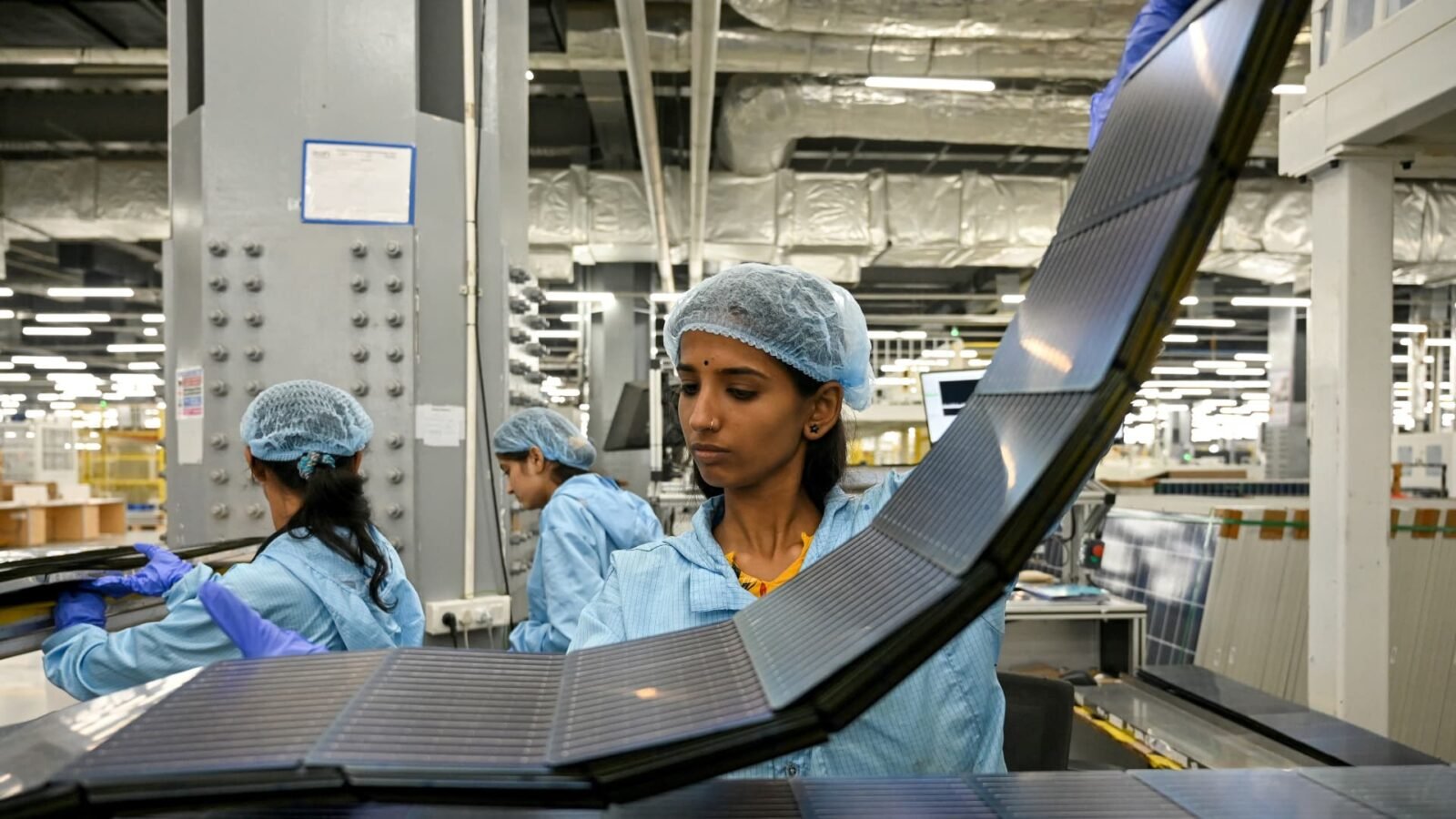
India has spent the past decade building out renewable power at a pace that has reshaped its electricity mix. Solar and wind plants now account for more than 40% of the country’s total generation capacity, roughly on par with coal-fired ones, according to data from the government think tank Niti Aayog. Yet the grid still runs mostly on coal, and fixing that gap is pulling New Delhi into a familiar bind with Beijing.
In the financial year ending March 2026, nearly 70% of the power generated in India was still coal-based, while just over 15% came from solar and wind projects. The discrepancy between capacity and actual output comes down to reliability: sunshine and wind are intermittent, and peak renewable output rarely lines up with peak demand.
Battery storage is the standard answer. It captures surplus green power and dispatches it when the grid needs it most. The problem, as experts told CNBC, is that close to 80% of the batteries used to store renewable power in India come from China, with most of the remainder sourced from South Korea and Taiwan. Domestic manufacturing covers less than 1% of the country’s estimated 260 gigawatt-hour demand pipeline, based on competitive tenders in 2026, according to research firm Wood Mackenzie.
Storage mandate could deepen reliance
Last week, India’s Central Electricity Authority proposed draft rules that would require all new government solar and wind projects commissioned after July next year to include battery storage. The measure is designed to make renewable supply more dependable and to reduce curtailment, the practice of forcing plants to cut generation when the grid cannot safely absorb or transmit power.
Storage can also bolster the finances of renewable producers by smoothing revenue and lowering that curtailment risk, said Ray Tay, executive director of project and infrastructure finance at Moody’s Ratings. Solar and wind availability, he noted, shifts with time of day, weather and season, and seldom peaks alongside demand.
But without a domestic battery industry to supply the mandate, the rules would push India further into dependence on Chinese imports — the opposite of the self-reliance goal driving the policy in the first place.
Ankita Chauhan, a director at Wood Mackenzie, described China’s position in the battery supply chain as a “critical advantage” that Beijing has previously wielded as a geopolitical tool to secure better trade terms. That assessment echoes broader warnings about concentration risk. Ashish Singla, director of South Asia power and renewable research at S&P Global Energy, told CNBC that China controls over 80% of global manufacturing capacity across several major battery supply-chain components, leaving India exposed to price swings, trade restrictions and technology bottlenecks.
Modi’s energy security pitch meets a supply-chain gap
Prime Minister Narendra Modi has framed power availability as central to India’s economic ambitions. “Energy security is the need of our times,” he said during his Independence Day speech last month, adding that it is becoming increasingly difficult to run the modern world without energy. The remark underscores how much electricity India will need to expand manufacturing, support local chip and artificial intelligence companies, and attract data center investment.
Relations between New Delhi and Beijing have warmed somewhat since Modi and Chinese President Xi Jinping met in Tianjin last year, and India has been easing investment rules for Chinese firms. Even so, friction persists. Indian executives reportedly face significant difficulty obtaining Chinese visas, India has imposed trade restrictions in sectors where it is closer to self-sufficiency, and China remains wary of technology transfers that could erode its grip on global supply chains.
The scale of the challenge is substantial. Wood Mackenzie estimates it could take more than a decade for India to build up local battery manufacturing. At present, most Indian companies are focused on downstream assembly and testing, or on batteries for mobility applications, which offer richer returns because of government subsidies.
Singla is more optimistic on one front: if execution stays on track and initiatives around critical minerals and recycling come together, India’s local cell manufacturing capacity could reach around 140 gigawatt-hours. Until then, the gap between India’s renewable ambitions and its ability to store the power it generates remains a strategic vulnerability that no amount of solar panel installation alone can close.
Source: www.cnbc.com — https://www.cnbc.com/2026/09/10/india-green-energy-china-reliance-battery.html
This article is for informational purposes only and does not constitute financial, investment, tax, or legal advice. Do your own research and consult a licensed professional before making financial decisions.