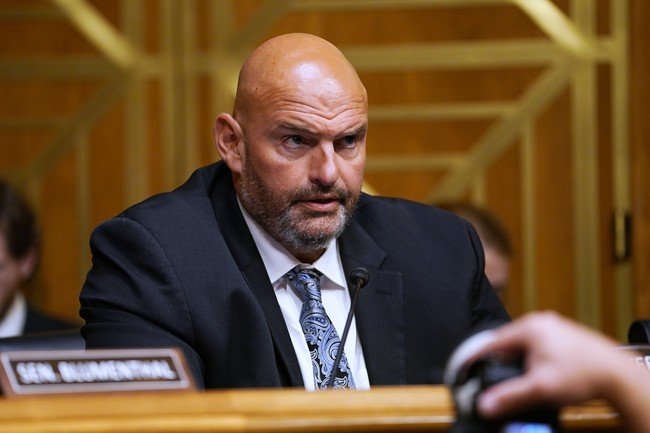
Sen. John Fetterman (D-Pa.) has spent the past few weeks delivering an uncomfortable message to his own party: Democrats have a socialism problem, and ignoring it won’t make it go away. According to a recent column by Matt Margolis at PJ Media, Fetterman is daring his fellow Democrats to listen before it’s too late—but so far, few on the left seem willing to take him seriously.
Fetterman hasn’t been subtle about who he’s talking about. He has specifically pointed to Michigan Senate nominee Abdul El-Sayed and the collapsed campaign of Graham Platner in Maine as evidence that the party is drifting in a dangerous direction. In a series of remarks, Fetterman called El-Sayed and candidates like him “these garbage kinds of people,” adding that they are dragging the party down. “I don’t care if he’s a fellow Democrat,” Fetterman said, explaining his willingness to criticize a member of his own party in public.
He didn’t stop with Michigan. Fetterman also singled out Maine Senate Democratic nominee Troy Jackson—Platner’s replacement—who has the backing of the Maine chapter of the Democratic Socialists of America and holds views strikingly similar to Platner’s.
“Our party has a socialism problem,” Fetterman said. “I’ll be the one Democrat that calls it for what it is and not use the euphemism that it’s a big-tent situation.” That dismissal of the “big tent” rhetoric is notable, as Democrats have often used that phrase to paper over internal ideological divisions.
Fetterman also brought up Hasan Piker, the popular left-wing streamer, whose past comments have become a liability. “Democrats like El-Sayed are proud to campaign with garbage like Hasan Piker,” Fetterman said. Piker once claimed “America deserved 9/11,” though he has since tried to walk back those comments. But Fetterman—and many others—believe his true views remain clear.

The irony, as Margolis notes, is that the very voters who most need to hear Fetterman’s warning are the least likely to listen. Fetterman’s approval rating among Republicans is higher than his approval rating among Democrats. That disconnect means that while he may be a Democrat in name, his message isn’t landing with the party’s base.
Margolis writes that he’s “doing the Democrats a favor” by highlighting this issue, because identifying a problem is the first step toward fixing it. He acknowledges that Democrats won’t listen to conservative commentators, but he wonders whether they’ll listen to one of their own senators. So far, the answer appears to be no.
Fetterman’s warnings come at a time when the party is already facing significant electoral challenges. The collapse of Platner’s campaign and the divisive candidacy of El-Sayed suggest that the socialist wing’s influence is a liability, not an asset, in key races. Fetterman’s willingness to call out his own side has made him unpopular among many Democrats, but he may end up being proven right if the party doesn’t change course.
Margolis predicts that Democrats will ignore Fetterman’s advice and that the party may even push him out by 2028. But he also suggests Fetterman could have the last laugh—because if Democrats don’t get their socialism problem under control, they’re going to face much bigger problems down the road.
For now, Fetterman appears to be a lone voice in the wilderness, a Democrat telling his party what it doesn’t want to hear. Whether anyone in a position of influence will listen remains an open question.
Source: pjmedia.com — https://pjmedia.com/matt-margolis/2026/08/28/democrats-cant-ignore-their-socialism-problem-much-longer-n4956660
This article is for informational purposes only and does not constitute financial, investment, tax, or legal advice. Do your own research and consult a licensed professional before making financial decisions.