
A closer look at recent earnings reveals a surprising distortion: the strong profit growth reported by major technology companies owes much to paper gains from venture investments, rather than operational performance alone.
Microsoft, Amazon, and Alphabet all recorded sizable investment gains during their most recent quarters, driven primarily by their stakes in artificial intelligence startups Anthropic and OpenAI, along with SpaceX in one case. With both AI companies now valued just below $1 trillion in private markets, the Big Tech shareholders holding these positions have seen their investment values soar.
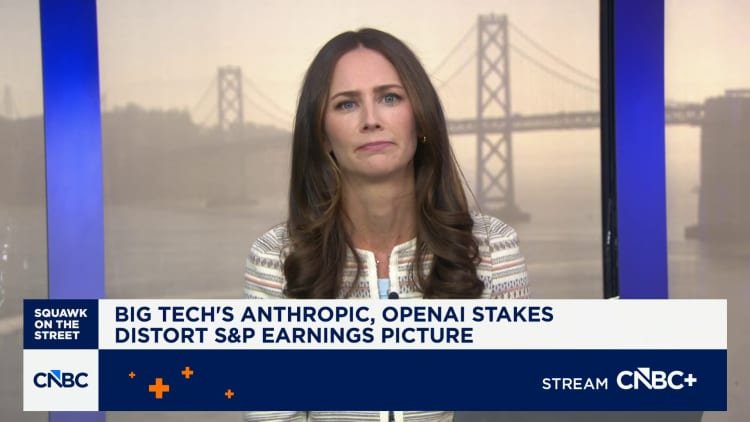
According to LSEG, the impact on overall market earnings has been substantial. Aggregate earnings growth for the S&P 500 in the most recent quarter reached approximately 48% year-over-year. However, when the investment gains from just Alphabet and Amazon’s private company stakes are excluded, that growth figure drops to roughly 29% — still healthy, but far closer to the 24% analysts had originally forecast.
The Magnitude of Individual Gains
Amazon saw earnings surge more than 240% compared to the prior year. Stripping out investment gains brings that figure down to approximately 17%. The e-commerce and cloud giant recorded a $53.4 billion gain “primarily from” its Anthropic investment during the quarter. Amazon has been a major backer of both OpenAI, committing $50 billion to the ChatGPT maker in late February, and Anthropic, where it was an early investor.
Alphabet experienced an even more dramatic headline result, with bottom-line growth surging nearly 300%. The bulk of that came from its roughly 5% stake in SpaceX, along with its Anthropic position. Without those two investments, the Google parent company’s earnings growth would have been closer to 23%.
Microsoft saw a more moderate but still meaningful impact, with investment gains adding about 10 percentage points to earnings growth. The company reported a net income gain of $3.2 billion mostly from Anthropic, plus a $480 million gain from its OpenAI stake.
Why It Matters for Investors
These accounting dynamics are particularly significant given the market dominance of mega-cap technology stocks. The Magnificent Seven accounted for about 35% of S&P 500 second-quarter revenue, according to LSEG, and have represented roughly a third of the overall large-cap index over the past year or so.
The earnings surprise effect has also been amplified. Companies this quarter reported results approximately 7% above analyst expectations, compared with a long-term average of 4.4% above consensus. Most analysts exclude these one-time investment items from their models, which helps explain the wider-than-usual beat rates.
Gil Luria, managing director and head of technology research at D.A. Davidson, noted that “the headline earnings numbers were very much inflated by equity gains in OpenAI, Anthropic and SpaceX,” according to CNBC. However, he added that “these types of moves tend to even out over time, which is why we typically exclude them from a non-GAAP view and from forecasts.”
Volatility Ahead
The flip side of mark-to-market accounting is that it works both ways. SpaceX, for instance, has declined roughly 50% from its high following its initial public offering. Luria suggested that based on current SpaceX trading levels, Alphabet will likely face a significant reversal in its mark-to-market accounting when it reports September quarter results. A successful Anthropic IPO in September could offset that impact, though the outcome remains uncertain.
Both Anthropic and OpenAI have filed confidentially with the SEC and are expected to list within the next year, which could further change the accounting dynamics as private stakes convert to publicly traded securities.
Despite the distortion, some market observers view the underlying picture as healthy. Jeff Kilburg, founder and CEO of KKM Financial, characterized the investment profits as “sprinkles” on top of an already strong earnings season, calling the corporate profit growth “jaw dropping” even without the private asset gains.
The episode underscores just how deeply intertwined Big Tech has become with the AI startup ecosystem — a relationship that’s now showing up in ways that materially affect how investors interpret market fundamentals.
Source: www.cnbc.com — https://www.cnbc.com/2026/08/03/big-techs-anthropic-and-openai-stakes-distort-corporate-earnings.html
This article is for informational purposes only and does not constitute financial, investment, tax, or legal advice. Do your own research and consult a licensed professional before making financial decisions.